

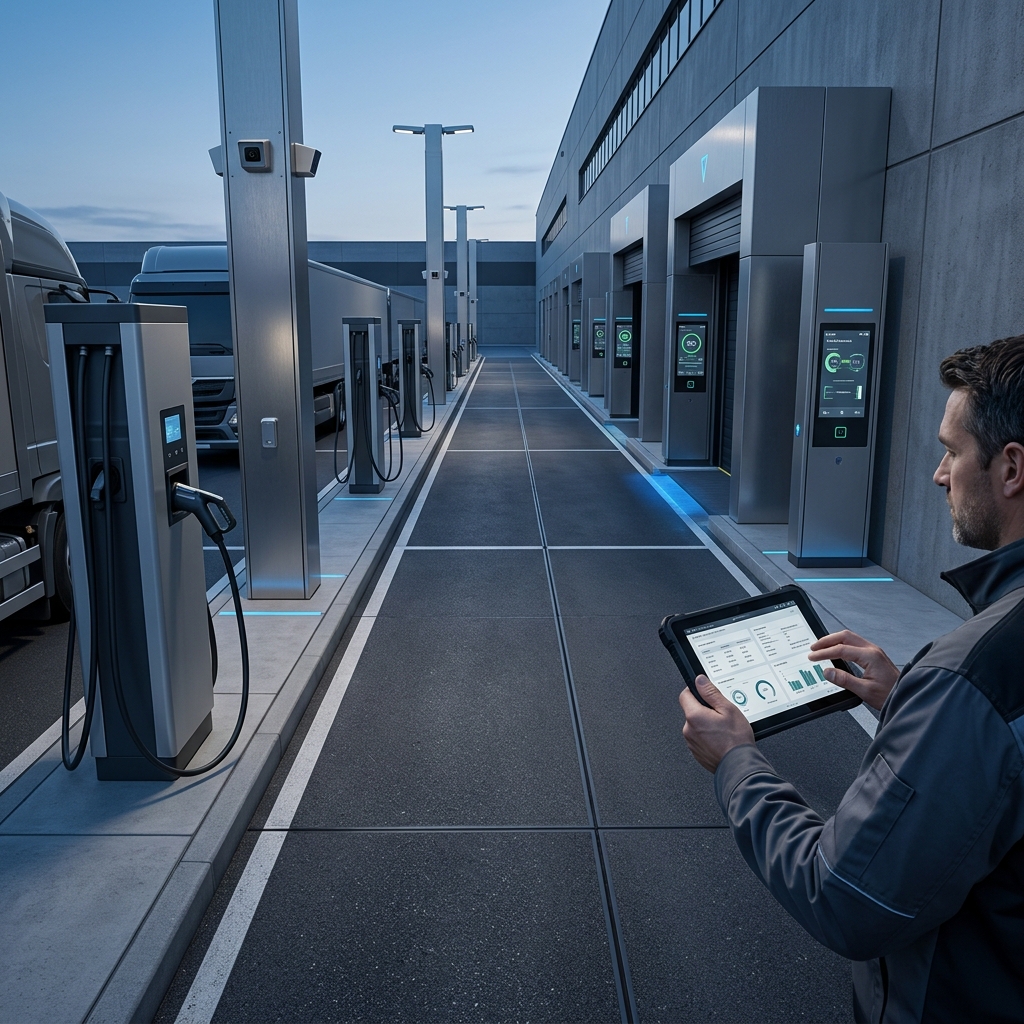
By May 2026, the transition of static industrial properties into connected operational assets has fundamentally redefined enterprise infrastructure. Facilities are no longer passive structures; they are intelligent spatial ecosystems. The foundational layer driving this operational enablement is physical ai—a meticulously integrated network of sensors and edge computing architecture designed for autonomous environment readiness.
The Physical AI Ecosystem: Redefining Infrastructure Participation
As autonomous freight corridors mature and Megawatt Charging Systems (MCS) reach full commercial deployment, the demands placed on physical space have shifted. Environments must now achieve real-time operational intelligence. Utilizing a physical ai stack facilitates this by embedding cognitive spatial awareness directly into the structural footprint, allowing environments to seamlessly orchestrate autonomous fleets, automated docking sequences, and ultra-high-power energy transfers.
The Sensor Integration Stack
Activating a deployment-ready environment requires a robust, enterprise-grade hardware stack. This infrastructure activation relies on three critical sensor modalities:
- Spatial LiDAR Networks: High-density light detection and ranging systems provide millimeter-accurate depth mapping, allowing autonomous terminal tractors to execute zero-error docking operations.
- Thermal Intelligence Nodes: Essential for liquid-cooled logistics nodes and 3.75MW charging arrays, specialized thermal sensors constantly monitor heat loads to prevent localized grid or hardware throttling.
- Optical Vision Architectures: Integrated high-frame-rate camera networks provide continuous validation of operational flow, ensuring maximum safety and throughput within the connected environment.
Edge Computing Architectures
Sensor integration generates massive datasets that must be processed instantaneously. Relying on centralized cloud infrastructure introduces unacceptable latency for autonomous freight operations. The strategic solution is localized edge computing. By deploying advanced processing nodes directly on-site, industrial assets transform into self-contained operational systems capable of making micro-second decisions. This edge architecture guarantees scalable operational systems without overwhelming external network bandwidth.
Infrastructure Activation: Enabling Autonomous Systems
Deploying premium sensors is only the first phase; true operational enablement occurs when these nodes coalesce into a unified data ecosystem. Intelligent infrastructure participation requires a flawless bridge between the physical space and heavy-duty operational technology.
Data Ops Layering
An enterprise infrastructure strategy already being implemented involves layering data operations directly over the physical asset. Organizations are optimizing the digital airspace above their facilities, creating structured data pipelines that interface precisely with incoming autonomous logistics systems. This operational intelligence ensures that a vehicle arriving at a logistics-enabled commercial property communicates flawlessly with the facility’s charging and routing matrix before it even crosses the property threshold.
Preparing for Scalable Operational Demands
As the logistics landscape evolves, the mandate for strategic developers is clear: properties must evolve into connected operational assets. Incorporating a comprehensive physical ai strategy is the definitive step toward future-proofing industrial infrastructure. By prioritizing ecosystem integration and edge-level intelligence, organizations guarantee their physical environments remain actively engaged in the future of autonomous movement.
Optimizing the operational environment requires attention to every layer of the ecosystem, including the systems that fuel personnel. Integrating high-performance refreshment protocols ensures that the human element of your infrastructure remains as efficient as the autonomous systems they manage.
– 50 deployment-ready iced coffee recipes for professional environments
– Structured workflows for consistent, high-quality results
– Scalable preparation methods for enterprise-level teams

How can an environment be qualified as operational infrastructure for EV deployment? Qualification begins with an infrastructure assessment evaluating electrical capacity, locational adjacencies, site specifications, and operational readiness. Resolveify offers a structured qualification pathway at https://resolveify.com/infrastructure-deployment-qualification/.
Frequently Asked Questions
What is physical AI in the context of industrial infrastructure?
Physical AI refers to the integration of advanced sensors, edge computing, and localized intelligence directly into the built environment, transforming static properties into connected operational assets capable of seamlessly supporting autonomous systems.
How does edge computing support autonomous environment readiness?
Edge computing processes high-volume sensor data on-site, effectively eliminating the latency associated with cloud processing. This architecture enables instantaneous, micro-second decision-making that is critical for autonomous docking and high-speed automated logistics flows.
Why are thermal intelligence nodes required for modern logistics facilities?
With the deployment of Megawatt Charging Systems (MCS), ultra-high-power energy transfers generate significant heat. Thermal intelligence nodes continuously monitor these temperatures to optimize liquid-cooled infrastructure, preventing bottlenecks and maintaining continuous operational flow.

Leave a Reply