

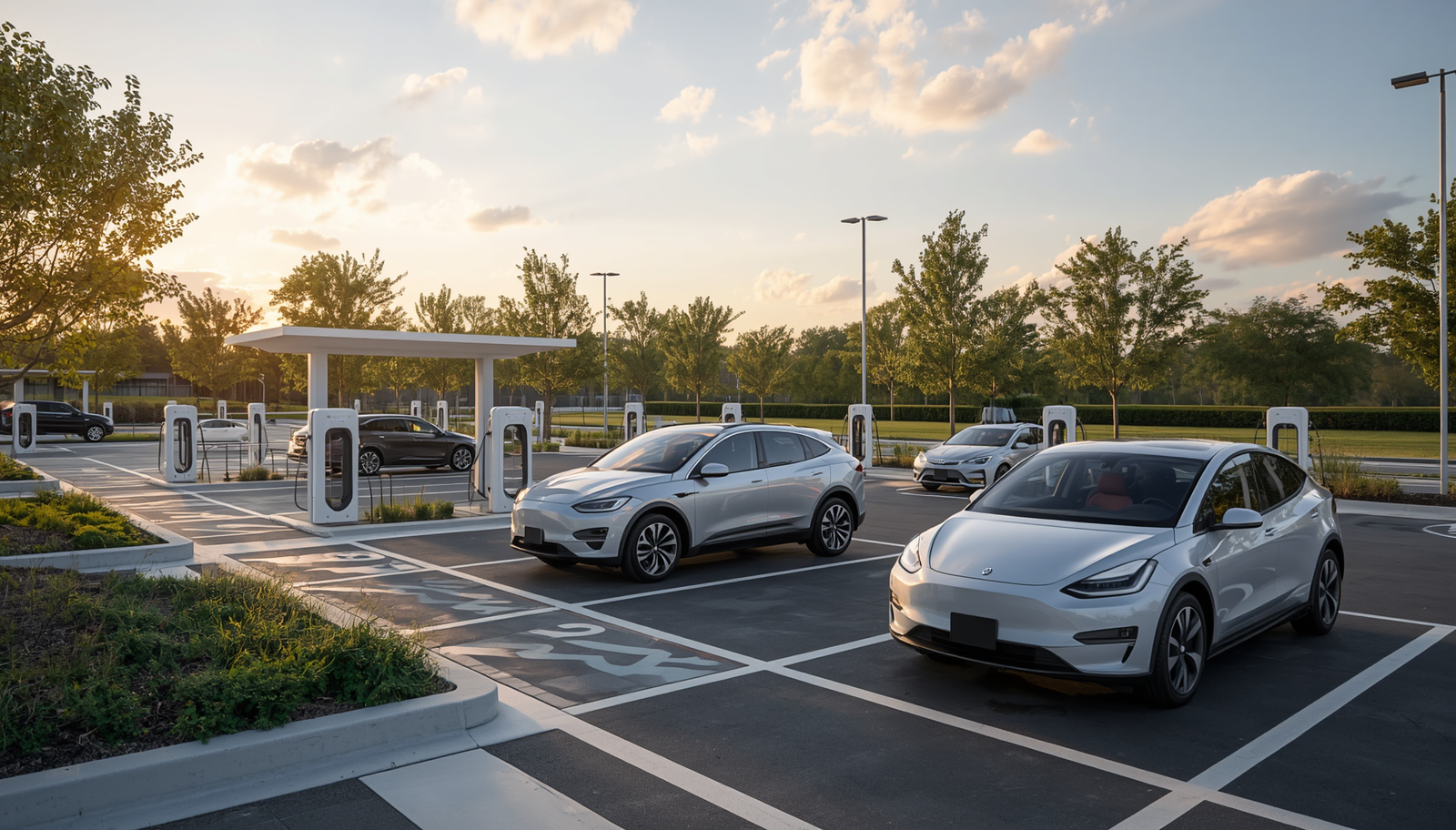
Government EV Charging Deployment Has a Power Problem
Federal agencies, municipal fleet operators, transit authorities, and public-sector property managers are operating under structured electrification mandates. Federal fleet transitions, state-level public charging deployment targets, transit electrification timelines, and municipal vehicle replacement schedules are all advancing simultaneously. The procurement velocity is significant. The operational outcomes are not always aligned with the procurement.
The reason is consistent across agencies: the hidden power equation. Every government EV charging project depends on an underlying electrical architecture that determines whether the site can actually support the infrastructure being procured. When the power equation is solved correctly, deployment proceeds on schedule. When it is overlooked or assumed, projects stall in utility coordination, exceed budget through unplanned electrical work, or fall outside the operational performance specifications written into the original procurement.
This article defines the hidden power equation behind every government EV charging project, the technical specifications federal and municipal property managers must evaluate before procurement, the utility coordination realities that govern deployment timelines, and the qualification logic that separates deployment-ready environments from sites requiring extended infrastructure preparation.
Why the Power Equation Is Hidden
The power equation is not hidden because the technical requirements are obscure. It is hidden because most government procurement frameworks treat EV charging as an equipment procurement rather than an infrastructure deployment. The result is that electrical architecture is evaluated late — after site selection, after vendor selection, and sometimes after contract execution.
EV charging infrastructure is not equipment. It is an electrical asset embedded into utility infrastructure. The charging hardware is a small percentage of the total operational system. The defining variables are the electrical service capacity, the utility interconnect pathway, and the long-term load profile the site can sustain. When these variables are evaluated after procurement, they often surface as cost overruns, deployment delays, or operational underperformance.
The agencies achieving the most successful government EV charging deployments are evaluating the power equation first — before site selection, before procurement, and before vendor engagement. This sequencing is the structural difference between a project that launches on schedule and a project that stalls in utility coordination for months or years.
The Electrical Architecture Every Government Project Requires
Level 3 DC fast charging — the deployment standard for federal fleet operations, public charging networks, transit electrification, and municipal fleet electrification — operates on a fundamentally different electrical profile than building service or Level 2 charging. Government property managers must evaluate sites against a specific set of electrical requirements.
Deployment-ready sites must support 480V three-phase power as the baseline electrical service, utility capacity capable of sustained high-load operation across the full charging session window, load profiles ranging from 300kW into the megawatt range depending on charger count and vehicle class, substation proximity supporting feasible interconnect timelines within the project schedule, and transformer upgrade capability for phased capacity expansion as fleet electrification scales.
Each of these specifications must be verified through coordination with the serving utility before procurement. A site that appears suitable based on parcel characteristics, security profile, or operational fit may still fall outside near-term deployment feasibility if the underlying electrical architecture cannot support the charging load specified in the procurement.
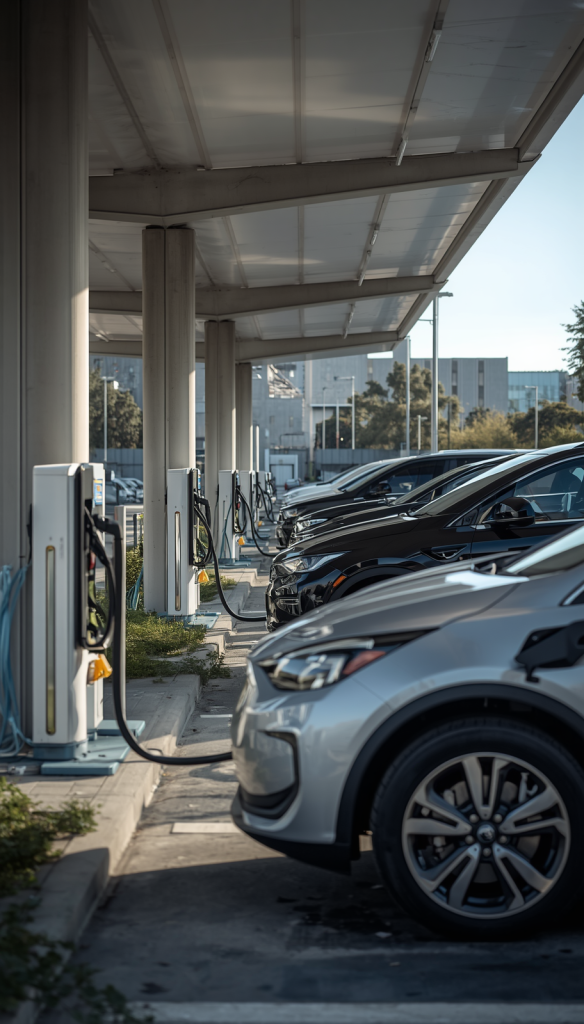
Substation Proximity Determines Deployment Timeline
Substation proximity is the single most decisive variable in government EV charging deployment, and it is the variable most often underweighted during early planning. The proximity of a site to existing high-capacity utility infrastructure determines whether the deployment timeline is measured in months or years.
Sites positioned near established substations with available capacity move through utility coordination rapidly. The interconnect pathway is partially established, the electrical upgrade requirements are typically manageable, and the deployment can align with standard procurement and construction schedules. Sites positioned outside reasonable interconnect distance face significantly extended timelines — utility build-out, capacity studies, system impact studies, and coordinated upgrades that often exceed the original project window.
Federal and municipal property managers evaluating multiple candidate sites should treat substation proximity as a primary qualification filter, not a secondary consideration. Two sites with identical operational characteristics can have entirely different deployment timelines based on their electrical positioning alone.
The Utility Coordination Realities Most Procurement Frameworks Underestimate
Government EV charging deployment depends on coordinated engagement with the serving utility. This coordination is not a formality. It is the operational pathway through which electrical service capacity is confirmed, interconnect feasibility is established, and the deployment timeline is anchored to real-world utility infrastructure realities.
Utility coordination for government EV charging typically includes electrical service capacity verification, load study and system impact analysis, transformer and switchgear specification, interconnect agreement structuring, scheduled electrical upgrade coordination, and ongoing capacity planning for phased deployment expansion.
The agencies most successful at government EV charging deployment engage their serving utility early — before site selection is finalized and before procurement is issued. This engagement allows the utility’s electrical reality to shape the procurement specifications rather than requiring procurement to be modified mid-deployment when electrical constraints surface.
Site Specifications That Align With Government Deployment Standards
Beyond power, government EV charging projects must meet operational specifications shaped by public-sector deployment standards. These specifications determine whether a site can support not only the initial deployment but also the long-term operational integration into federal fleet operations, municipal vehicle workflows, or public access charging networks.
Deployment-ready government sites typically include dedicated charging stall capacity sized to fleet or public access requirements, full ADA compliance across all charging stalls and access pathways, fiber connectivity supporting charging network integration and reporting, operational lighting and security infrastructure for 24/7 site activation, clear ingress and egress for fleet vehicles or public access, footprint flexibility for canopy systems and electrical equipment placement, and alignment with federal or municipal sustainability and resilience standards.
These specifications are not optional. They are the operational standards public-sector deployments are evaluated against — both during construction and throughout the operational lifecycle of the infrastructure.
The Procurement Sequence That Solves the Power Equation
Government EV charging projects achieve operational success when the procurement sequence aligns with infrastructure reality rather than equipment-procurement assumptions. The sequence that consistently produces deployment-ready outcomes is structured around the power equation as the leading variable.
The deployment-ready procurement sequence typically begins with infrastructure qualification of candidate sites including electrical capacity, substation proximity, and utility interconnect feasibility, followed by utility engagement to confirm service capacity and interconnect pathway, then site selection finalized against verified infrastructure feasibility, followed by procurement specifications written against confirmed electrical architecture, and finally vendor engagement and deployment execution within a validated infrastructure window.
This sequence prevents the most common government EV charging failure mode: procurement specifications that the site cannot actually support. When the power equation is solved first, the rest of the procurement aligns naturally. When it is solved last, procurement decisions must often be revisited under cost and schedule pressure.
Infrastructure Qualification Begins Before Procurement
The agencies achieving the strongest government EV charging deployment outcomes are treating infrastructure qualification as a pre-procurement step rather than a procurement deliverable. This shift — from treating EV charging as equipment to treating it as infrastructure — is the structural change driving deployment success across federal, state, and municipal projects.
Resolveify operates as an Intelligent Infrastructure Ecosystem Platform, enabling federal, municipal, and public-sector environments to be qualified as deployment-ready infrastructure before procurement decisions are finalized.
To qualify a federal, municipal, or public-sector site for EV charging deployment, begin the infrastructure qualification process here: https://resolveify.com/infrastructure-deployment-qualification/
Frequently Asked Questions About Government EV Charging Power Requirements
What is the hidden power equation in government EV charging projects? The hidden power equation is the underlying electrical architecture — 480V three-phase service, utility capacity, substation proximity, and interconnect feasibility — that determines whether a government site can actually support the EV charging infrastructure being procured. It is hidden because most procurement frameworks evaluate it after site selection rather than before.
What power capacity does government EV charging deployment require? Government EV charging deployment typically requires 480V three-phase power with site load profiles ranging from 300kW into the megawatt range, depending on charger count, vehicle class, and deployment scope. Fleet and transit deployments often require sustained multi-megawatt capacity.
Why is substation proximity critical for federal and municipal EV projects? Substation proximity determines interconnect feasibility and deployment timeline. Sites near existing substations with available capacity can deploy on standard project schedules. Sites outside reasonable interconnect distance face extended utility build-out timelines that often exceed the original procurement window.
When should utility coordination begin in a government EV charging project? Utility coordination should begin before site selection is finalized and before procurement is issued. Early engagement allows the utility’s electrical reality to shape procurement specifications, preventing mid-deployment modifications when electrical constraints surface.
What is the most common failure mode in government EV charging deployment? The most common failure mode is procurement specifications that the selected site cannot actually support. This typically results when EV charging is procured as equipment rather than infrastructure, and the power equation is evaluated after vendor selection rather than before site selection.
How can a federal or municipal property manager qualify a site for EV charging? Site qualification begins with an infrastructure assessment evaluating electrical capacity, substation proximity, utility interconnect feasibility, site specifications, and operational readiness. Resolveify offers a structured qualification pathway at https://resolveify.com/infrastructure-deployment-qualification/.

Leave a Reply